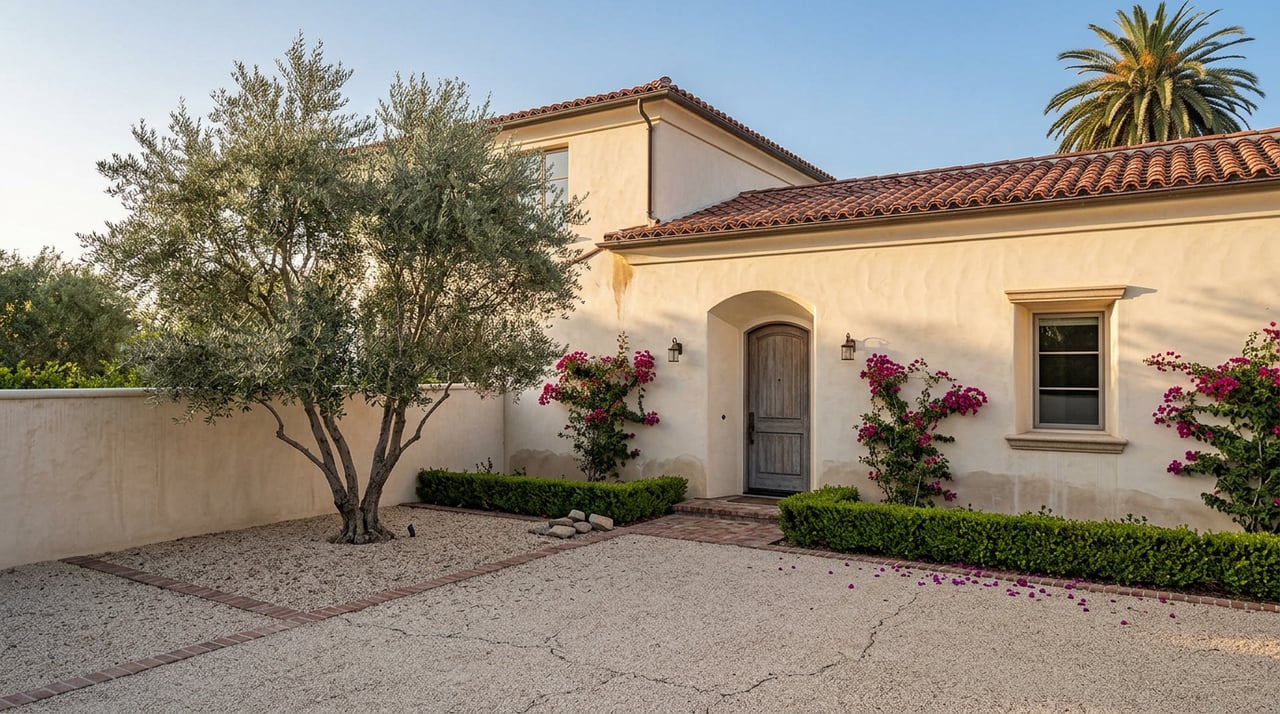
Behind the Gate on Moorpark Street: Encino's Best-Kept Sunday Secret
September 17, 2026
September 17, 2026
There is a low iron gate on Moorpark Street, one block off Ventura Boulevard, that most people driving past have never opened. No awning, no sandwich board, nothing that signals it belongs on a list of things to do. Behind it sits a spring-fed pond, a limestone house built in 1872, and an adobe older than the city of Los Angeles as most people would recognize it today. On one Sunday afternoon a month, that quiet gate turns into the most interesting two hours in the neighborhood, and almost nobody plans their day around it, because almost nobody knows the schedule.
Encino already has a Sunday routine everyone can recite: farmers market in the morning, something on Ventura Boulevard for dinner. What gets left out of that routine is the middle piece, sitting geographically and chronologically between the two, that only shows up a handful of times a year. Here is the full shape of that day, including the part that usually gets skipped.
The Encino Farmers Market has been setting up on Sunday mornings for more than twenty years, and most locals could find it with their eyes closed. What fewer people notice is that the mailing address, 17400 Victory Boulevard between White Oak and Balboa, technically puts it in Van Nuys. It has carried the Encino name for two decades anyway, because that is who shows up.
The market runs 8 a.m. to 1 p.m., every Sunday, rain or shine, with more than 30 California farmers, over 25 food vendors, and around 10 crafters selling soap, jewelry, and clothing on a given weekend. It is organized by ONEgeneration, a nonprofit that runs senior services out of the same Van Nuys campus, and a share of every dollar spent at a stall goes back into those programs. That is a detail worth knowing if you have ever wondered why a produce stand feels like it is doing more than selling produce. It is.
Encino's version of the market rotates with the seasons the way any real farmers market does. Spring brings cherries, apricots, and asparagus. By fall the tables shift to persimmons, pomegranates, and winter squash. If you have only ever gone in one season, you have only seen a quarter of what the market actually is.
Sunday, 8 a.m. to 1 p.m., every week, for more than twenty years. Rain or shine.
That consistency is the whole point. It is also exactly why the next stop on the day gets overlooked. When one anchor is this reliable, it is easy to stop looking for a second one.
A five-minute drive south, at 16756 Moorpark Street, sits Los Encinos State Historic Park, a 4.7-acre site the state has owned since 1949 but that has been continuously inhabited far longer than that. The land was the location of Siutcanga, a village of Tongva people who relied on a natural spring here for water long before the 1769 Portola expedition passed through and named the surrounding valley after the oaks that covered it.
The spring is still there. So is the pond it feeds, built in 1874 by rancher Eugene Garnier, and the two-story limestone Garnier building he constructed two years earlier. Vicente de la Osa built the original nine-room adobe on the property in 1849, and it still stands alongside a blacksmith shop near the water. Coin-operated machines by the pond sell duck feed for a quarter a turn, because bread is bad for the ducks' digestion and the park would rather you not bring your own loaf.
Most days, this is a quiet stop. A place to let kids feed ducks, take a slow lap around the pond, and read a plaque or two. That version of Los Encinos shows up in every generic guide to the neighborhood.
What those guides miss is Heritage Days, a free program the state park runs one Sunday afternoon most months, from 1 to 3 p.m., where the site turns into a working demonstration of 19th-century ranch life rather than a static exhibit. The 2026 schedule lands on:
That means the gate on Moorpark Street has a living-history afternoon scheduled for this month, on September 20. It is the kind of thing you would only know if you checked the calendar, because nothing about the building or the sidewalk in front of it changes on the days it happens.
For anyone who wants to turn the loop into a longer outing, the neighborhood's real backyard sits just north of the park. Sepulveda Basin Recreation Area covers roughly 2,000 acres bordered by Burbank, Balboa, Victory, and Woodley, and inside it are three golf courses, an off-leash dog park, a model airplane field, and the Sepulveda Basin Wildlife Reserve, where more than 200 bird species have been documented across 225 acres of restored habitat.
| Option | Distance or Area | Typical Time |
|---|---|---|
| Lake Balboa paved loop | 1.3 miles around the lake | About 30 minutes, walking |
| Sepulveda Basin perimeter loop | Roughly 9 miles by bike | Half a morning, cycling |
| Wildlife Reserve nature trails | 225 acres, two sections | Varies, self-paced |
Lake Balboa itself, officially Anthony C. Beilenson Park, sits on the north side of the basin with a 27-acre lake at its center. The paved path around it runs 1.3 miles, long enough for a real walk without needing to plan for it, and the western edge lines up with cherry trees that bloom pink each March if you happen to be timing a visit around that.
None of this is new information to anyone who already bikes the basin on weekends. What is easy to forget is how close it sits to both the farmers market and the historic park. All three fit into the same few square miles, which is what makes stacking them into one day possible without much driving at all.
By early evening, Ventura Boulevard is the obvious move, and the newest addition to that strip opened this year. Popular, from Tel Aviv Restaurant Group, took over a 4,000-square-foot space at 18047 Ventura Boulevard in March 2026, its seventh concept from the same group. Executive chef Dor Priezler built the menu around Mediterranean fusion with a seafood lean, including a Fish Cigar starter, a crisp pastry filled with branzino, herbs, chili, and lemon zest, alongside a savory take on baklava filled with cheese instead of nuts.
It is one restaurant among many along that stretch, but it is the one that did not exist a year ago, which makes it a small marker of how much the boulevard keeps shifting even in a neighborhood that otherwise feels settled.
Put those four pieces next to each other and a pattern shows up that no single listing captures on its own. The market opens at 8, closes at 1. The park sits open to walk through any day, but only turns into something worth planning around eight Sundays a year. The basin is there whenever you want more miles. Dinner is a five-minute drive from all of it.
Most guides to Encino treat these as four separate entries on four separate lists: a market, a park, a trail system, a restaurant strip. None of them mention that on a specific Sunday each month, the middle stop on that list becomes something else entirely, and that the difference between an ordinary Sunday and a memorable one in this neighborhood often comes down to whether you checked a state park's calendar before you left the house.
September 20 is one of those Sundays. The gate on Moorpark Street will be open the way it always is. What happens behind it for two hours that afternoon is not.
Lori Morrissey has spent more than two decades working in and around this stretch of the San Fernando Valley, and part of that work is simply paying attention to what makes a neighborhood function the way it does day to day. If you are curious what a home in this pocket of Encino is actually worth in today's market, Lori Morrissey Luxury offers a free home valuation with no pressure attached, just a straight answer from someone who knows the streets in question.
With over two decades of experience, exceptional market knowledge, and a commitment to community growth, you'll receive expert guidance, personalized service, and proven results every step of the way.
Morrissey, Lori Lynne | CA DRE# 01362129
Stratton - LFCA, Inc. | CA DRE# 02211662
[email protected]
(818) 395-5212
License #23345566
Encino, CA 91316