Sherman Oaks Condos and the Balcony Deadline That Already Came and Went
August 27, 2026
August 27, 2026
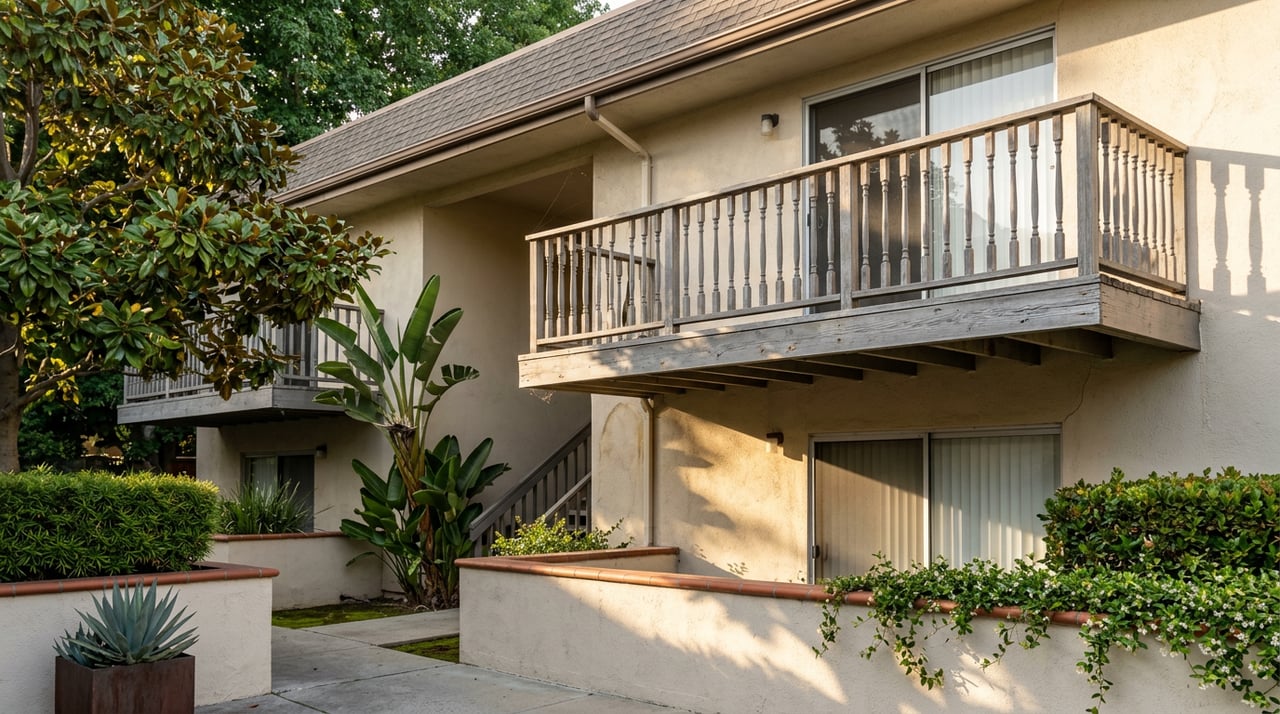
Picture two condo buildings a few blocks off Ventura Boulevard. One went up in the late 1970s, garden-style, wood balconies overlooking a shared courtyard. The other finished construction more recently, concrete and steel, a few floors of podium construction near the Village at Sherman Oaks. Same neighborhood, similar price range, similar-looking HOA paperwork in a listing packet.
Only one of those buildings had a hard state deadline land on it last year. The other one legally never will, no matter how old it gets.
That split is the thing worth understanding before you write an offer on a Sherman Oaks condo, or before you list one. California's balcony inspection law does not apply evenly across condo buildings. It applies to a specific kind of construction, and whether a given HOA has already complied, is scrambling to catch up, or was never on the hook in the first place depends on the building's structure and history, not its price tag or its zip code.
The law is Senate Bill 326, codified in Civil Code section 5551. It requires condominium associations governing buildings with three or more units to inspect exterior elevated elements, meaning balconies, decks, stairways, and walkways, whenever those elements extend beyond the exterior wall, sit more than six feet above ground, and are substantially supported by wood.
The first inspection cycle for condo HOAs had to be completed by January 1, 2025. There was no extension for condominiums. That matters because the companion law covering apartment buildings, SB 721, did get a one-year reprieve, pushing that deadline to January 1, 2026, under Assembly Bill 2579. Both dates have now passed, but they passed a full year apart. A condo HOA next door to a rental apartment building spent that entire year on a different clock than its neighbor. If you have been assuming every multifamily building in Sherman Oaks was working from the same compliance timeline, it was not.
Inspections must be performed by a licensed structural engineer or architect, with civil engineers added to the approved list later. General contractors, even experienced ones, are not authorized to sign off on an SB 326 inspection. Associations that hired a contractor instead of an engineer may be sitting on a report that does not actually satisfy the law, which is its own quiet risk for anyone buying into that HOA.
| SB 326 (Condo HOAs) | SB 721 (Rental Apartments) | |
|---|---|---|
| First inspection deadline | January 1, 2025, no extension | January 1, 2026, after AB 2579 extension |
| Re-inspection cycle | Every 9 years | Every 6 years |
| Who can inspect | Structural engineer, architect, or civil engineer | Broader range, including qualified contractors |
| Sampling standard | Statistically significant sample, generally more elements than the flat minimum | At least 15% of elements |
Both deadlines are behind us now, but a full year apart. That gap is long enough for a condo HOA's compliance history to already be sitting in its files while a nearby apartment building's is still fresh.
The law only reaches wood-supported elements. Concrete or steel balconies typically fall outside SB 326 entirely, and the statute excludes planned developments, meaning communities where each owner maintains their own structure rather than the HOA. So a true condominium with HOA-maintained wood balconies from the 1970s or 80s carries real exposure. A newer concrete podium building a few doors down, or a planned development where owners handle their own upkeep, may never trigger the law at all.
Sherman Oaks has both kinds of stock sitting side by side. Ventura Boulevard saw waves of high-rise and mid-rise construction stretching from the mid-1960s into the late 1980s, which is exactly the era that produced a lot of the wood-framed garden-style condo buildings still standing today. Newer concrete and mixed-use buildings have continued to rise elsewhere in Sherman Oaks in more recent years. Two buildings that look comparable in a listing photo can carry completely different legal obligations, and completely different financial exposure, depending on when they were framed and what material holds up the balconies.
This is the piece a median price can't tell you. Comparing two condos by square footage and list price alone skips the question that actually determines whether you're buying into a building with a compliance history to review or one that was never subject to the law in the first place.
If an inspection turns up deterioration or a life-safety issue, the report has to go to the board, and the board has to distribute a written summary to owners within 15 days of receiving it. That distribution requirement is one of the more useful things a buyer can ask about directly, because it means a well-run HOA should have a paper trail showing exactly when owners were told about any findings.
Deficiencies also have to be folded into the association's reserve study. For a mid-size condo complex, the inspection itself typically runs somewhere between $15,000 and $50,000 depending on the number of qualifying elements. Repairs are a separate line item, and a larger structural project can run considerably higher, with real-world special assessments for major work landing anywhere from a few hundred dollars to $20,000 or more per homeowner, and occasionally into six figures per unit for serious structural failures.
Here's the mechanism that decides whether owners get a vote on that bill. Under Civil Code section 5605(b), a board can levy special assessments totaling up to 5% of the association's budgeted gross expenses for the year without asking members to approve it. Anything above that threshold requires a homeowner vote under most governing documents. So a modest repair bill might show up as a line-item assessment with no advance warning to a buyer reading old board minutes, while a larger one leaves a vote on record you can actually go find.
SB 326 exists because of one incident. A wood balcony at a Berkeley apartment complex collapsed in 2015 after severe wood decay from water intrusion, and that tragedy pushed California lawmakers to require standing inspections for exactly this kind of structure going forward.
If you're under contract on a Sherman Oaks condo, or thinking about listing one, these are the documents worth requesting directly rather than assuming they'll surface on their own:
None of this tells you whether a specific building is a good buy. It tells you whether you're looking at a building the law has already reached, or one still waiting its turn, and what that association has done about it either way.
Does SB 326 apply to townhomes in Sherman Oaks? Yes, if the HOA is responsible for maintaining the structure and the balconies or decks are wood-supported and more than six feet above grade. If it's a planned development where each owner maintains their own exterior elements, the law generally does not apply.
My building already passed inspection with no issues. Does that mean I'm in the clear? Ask to see the actual report and its date. Compliance is good until the next required cycle, nine years out for condos, so an old clean report is not the same as a current one.
Can I check an association's compliance status before I even write an offer? Yes. Associations are required to make governing documents, financials, and reserve information available to prospective purchasers under the Davis-Stirling Act, so this is a reasonable request to make early rather than waiting until you're deep into escrow.
Whether you're comparing two Sherman Oaks condos that look identical on paper or trying to figure out what a pending inspection report might mean for your own building's value, the construction era and the paperwork behind it matter more than the price per square foot. Lori Morrissey has spent more than two decades working Sherman Oaks and the surrounding San Fernando Valley and can help you read what an HOA's compliance history actually means for your purchase or your listing. If you're weighing a sale, start with a free home valuation and a conversation about where your building stands.

With over two decades of experience, exceptional market knowledge, and a commitment to community growth, you'll receive expert guidance, personalized service, and proven results every step of the way.

Morrissey, Lori Lynne | CA DRE# 01362129
Stratton - LFCA, Inc. | CA DRE# 02211662
[email protected]
(818) 395-5212
License #23345566
Encino, CA 91316